
Express Investor Interest!
Certified Innovative Enterprise in Cyprus
What this designation means, how it is evaluated, and why it matters to investors reviewing WOSOM
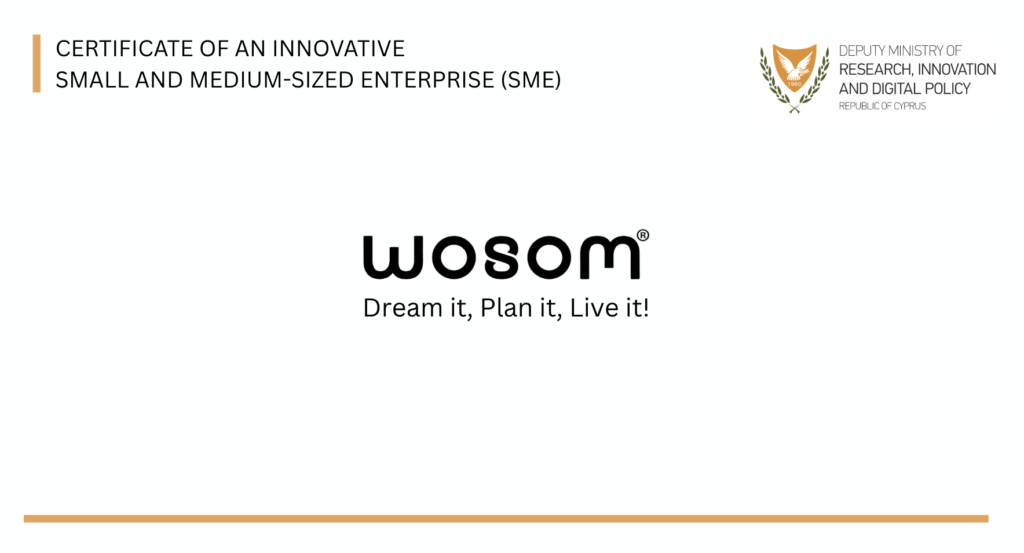
WOSOM has been officially recognised as a Certified Innovative Enterprise in Cyprus.
This page explains what that designation means, how startup companies are evaluated under this framework, and why the certification may matter to investors seeking additional signals of credibility, structure, and innovation readiness.
This page is focused specifically on the certification itself. Investors who want to explore WOSOM more broadly can also review the Investment Case, Leadership, Media Hub, and Data Room sections of this site.
What Is a Certified Innovative Enterprise in Cyprus?
A Certified Innovative Enterprise is a company that has been formally recognised within the Cyprus innovation framework as meeting defined criteria for innovation.
This is not simply a branding label or a broad statement of ambition. It is part of an official framework designed to identify innovative small and medium-sized enterprises and to provide a structured basis for recognition within the national innovation ecosystem.
For investors, partners, and strategic stakeholders, this matters because it places the company within a formal process rather than an informal claim. It offers context. It indicates that the company has gone through a recognised pathway used to distinguish innovation-driven businesses from ordinary early-stage commercial activity.
In practice, the certification acts as an additional layer of credibility around the company’s innovation profile. It does not replace commercial assessment, investor judgment, or due diligence. What it does provide is an external, framework-based signal that the company has been assessed under criteria relevant to innovation, business quality, and development potential.
Why This Is More Than a Badge
For startup companies without a financial history, this certification is not granted on the basis of marketing language, optimistic positioning, or generic startup ambition.
It is tied to structured evaluation.
That distinction is important. Many early-stage businesses describe themselves as innovative. Far fewer have been reviewed under a defined process that examines whether their business plan demonstrates the capacity to develop new or significantly improved products, services, or processes with real technological or industrial risk.
This is why the certification has meaning beyond reputation alone.
For a startup, the designation reflects more than an idea. It reflects the fact that the company has entered and passed a formal assessment environment designed to test the seriousness, logic, and potential of what is being built.
That does not mean the certification is a guarantee of success. It does mean that the company has been reviewed through a more disciplined lens than self-description.
For investors unfamiliar with the Cyprus innovation framework, this page provides a clear overview of what the certification is, why it matters, and how it can strengthen the broader investment case.
How Startup Companies Are Evaluated
For startups without financial history, the certification process includes evaluation of the business plan by independent evaluators.
This is one of the most important aspects of the framework.
To be considered eligible, the business plan must meet defined score thresholds. The assessment is not based on one vague impression or one generic innovation claim. It is built around three formal criteria, each of which must be met at a sufficient level.
1. Implementation
This criterion examines the team’s capability to develop new or clearly improved products, services, or processes involving high technological or industrial risk.
It also considers the team’s motivation and commitment to bring the innovation to market, together with the relevance of prior experience to the company’s business.
In practical terms, this is about whether the company appears capable of executing what it claims.
2. Impact
This criterion focuses on the commercial side of the business plan.
It looks at the business model, go-to-market and commercialisation strategy, intellectual property approach, financial planning, scalability, growth prospects, and the quality of market and competition analysis.
This matters because innovation alone is not enough. A startup also needs a credible path to market, a coherent strategy for growth, and a realistic understanding of the business environment in which it operates.
3. Excellence
This criterion evaluates the soundness, credibility, feasibility, and timing of the proposed idea.
It also considers the degree of innovation, the advancement over the current state of the art, and the potential to create a new market or generate meaningful impact within an existing one.
This is where novelty, relevance, and feasibility come together. It asks not only whether the idea is innovative, but whether the proposed innovation is strong, credible, and capable of delivering meaningful value.
Why the Evaluation Structure Matters
The value of this framework lies in its structure.
The business plan is evaluated against multiple criteria rather than a single narrative claim. A startup must demonstrate not only innovation, but also execution logic, commercial relevance, and feasibility. This makes the certification more meaningful than simple recognition language and more useful to external stakeholders trying to understand what has already been assessed.
What This Can Signal to Investors
For investors, the significance of this certification is not that it replaces independent judgment. It does not.
Its value is that it may serve as an additional external signal when reviewing an early-stage company.
In the case of a startup, the certification can suggest that the company has already been examined within a structured framework that looks at several issues investors themselves care about, including implementation capability, commercial impact, and the feasibility of the innovation.
This can be relevant for investors who are assessing multiple early-stage opportunities and want to distinguish between unstructured ambition and ventures that have already passed through a more formal review process.
In other words, the certification does not tell an investor everything. It does, however, indicate that the company has not relied only on internal claims to describe itself as innovative.
That added context can be useful, especially when combined with the company’s broader materials.
To review WOSOM more fully, investors can explore the pages below:
Investor Incentives Under the Cyprus Framework
The Cyprus framework also includes tax incentive provisions for eligible investments in innovative enterprises, subject to conditions, limits, eligibility rules, and the applicable legal framework.
This is relevant, but it should be understood carefully.
Tax treatment depends on the profile of the investor, the legal structure of the investment, the timing, the type of securities acquired, and the conditions in force at the time of investment. For that reason, any investor should always seek independent professional tax and legal advice before making an investment decision.
The purpose of this page is not to provide tax advice. It is simply to acknowledge that the certification sits within a broader framework that may carry additional practical relevance for certain eligible investors.
What This Means in the Context of WOSOM
In the context of WOSOM, the Certified Innovative Enterprise designation should be understood as one part of a broader investor information structure.
It is not intended to tell the entire company story on its own.
Instead, it provides focused context around one specific point: WOSOM has received formal recognition within the Cyprus innovation framework, and that recognition is linked to a structured evaluation process rather than a broad promotional statement.
For investors and stakeholders reviewing WOSOM, this page is therefore best read as a credibility and context layer.
To understand the company more fully, you can continue through the wider investor information journey:
- The Investment Case explains the market problem, platform opportunity, and broader company rationale.
- The Leadership page introduces the people behind WOSOM.
- The Media Hub highlights company milestones and developments.
- The Data Room provides a pathway to confidential materials for qualified interest.
FAQ
What is a Certified Innovative Enterprise in Cyprus?
A Certified Innovative Enterprise is a company formally recognised within the Cyprus innovation framework as meeting defined criteria for innovation.
Is this certification just a marketing label?
No. For startup companies without financial history, the certification is linked to business plan evaluation under defined criteria rather than branding claims alone.
How are startup companies evaluated?
Their business plan is evaluated by independent evaluators against formal criteria focused on implementation, impact, and excellence.
What do evaluators look at?
They assess areas such as execution capability, commercial strategy, scalability, financial planning, feasibility, innovation level, and market relevance.
Does the certification replace investor due diligence?
No. It should be seen as an additional signal within a broader investor review process, not as a substitute for due diligence.
Does the certification guarantee commercial success?
No. It indicates that the company has passed through a structured evaluation framework. It does not guarantee market adoption, growth, or investment outcomes.
Is there a wider investor framework connected to this certification?
Yes. The certification exists within a broader Cyprus framework that may include investor incentive provisions for eligible cases, subject to current legal conditions and professional advice.
Where can I learn more about WOSOM itself?
You can continue through the Investment Case, Leadership, Media Hub, Data Room sections of this site Or Book an Appointment
Quick Links
Wosom Global Limited
A Cyprus-registered company Company (No: HE482953)
15, Ayias Paraskevis str. 2002, Nicosia, Cyprus